Soaring Freight Costs Make Japan’s Crude Imports the World’s Most Expensive
Oil is increasingly getting more expensive before it even reaches a refinery. Freight now accounts for roughly a fifth of the cost of a crude cargo, turning the tanker market into a major driver of the price buyers pay. At the center of the squeeze is the very large crude carrier, or VLCC, the supertanker that can move about 2 million barrels in a single voyage. Amidst stranded Gulf and Red Sea supplies, these vessels are spending more time at sea as refiners search farther afield for supplies. For instance, Indian buyers are now reaching into Guyana and Brazil, committing ships to journeys of 30 to 40 days. Smaller tankers, be they Aframaxes or Suezmaxes, offer little substitute for moving such large volumes over those distances.
Meanwhile, the Strait of Hormuz is drawing some of the VLCC into short, expensive shuttle runs. Around 60 vessels are carrying crude through the strait to the Gulf of Oman, where it is ship-to-ship (STS) transferred to other tankers for the onward journey. The oil moves in stages, and the delays accumulate. VLCCs waiting for STS transfers reportedly spend around 10 days in queues, tying up capacity that would otherwise serve the wider market.
For the crude that emerges from the Gulf, the cost of that first short passage can weigh heavily on the entire voyage. The Hormuz shuttle to Fujairah or Sohar adds around $15-20/bbl, equivalent to $20 million for a fully loaded VLCC. Some reported charges for moving Saudi crude through the strait to a Gulf of Oman transfer point run as high as $16-20/bbl, compensating owners and crews for the risk. Some shipping companies refuse the crossing altogether, while others ask for extreme rates.
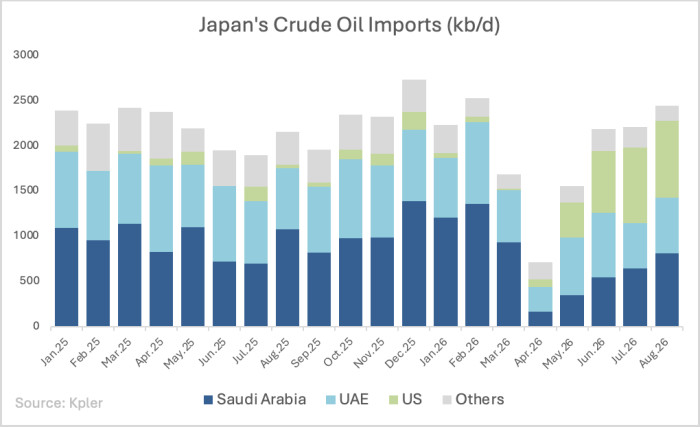
Few countries illustrate that exposure more clearly than Japan. A VLCC voyage from the US Gulf Coast to Japan now costs about $53 million lumpsum, or roughly $26-28/bbl. This number is an important factor of Japan’s exports strategy. Since the war between the US and Iran led to the closure of Hormuz in March, the US has become Tokyo’s largest crude supplier. Japan imported 860,000 b/d from the US in August (35% of its 2.45 million b/d total), compared with just 65,000 b/d in February. Those cargoes sail around the Cape of Good Hope, a journey averaging 50 days.
Saudi Arabia and the UAE remain Japan’s next two largest suppliers, but their role has shrunk. Before March, they jointly accounted for 80% to 90% of Japanese crude imports, with Saudi Arabia supplying an average of 1 million b/d and the UAE 800,000 b/d in 2025. Since the conflict began, their combined share has dipped to around 50%. The search for alternative routes has taken Japanese buyers as far as Saudi cargoes loaded at Yanbu and shipped through the Suez Canal and around the Cape of Good Hope, a trip of about 60-65 days (if counting waiting time for ship-to-ship loadings).
Japan’s purchasing needs also extend beyond keeping its refineries supplied. The reserves that cushioned the initial shock now need replenishing, bringing another buyer (the Japanese government) into an already expensive market. Government-held crude stood at 263 million barrels, or 103 days of cover, when the crisis began. The government announced an initial release of about 80 million barrels (both from public and private reserves) in March and a further 20 days’ worth, or roughly 36.5 million barrels, in July. It made no releases in August or September and said that not all the volumes made available were used. However, by the end of July, government-owned reserves stood at roughly 182 million barrels.
In August, a committee at Japan’s Ministry of Economy, Trade and Industry approved a program to restore government reserves to about 90 days of cover. The goal for fiscal 2027 is to cover 90 days of crude imports, which would suggest that Tokyo needs to replenish roughly 48 million barrels of crude. State energy agency Jogmec has since bought Murban crude for delivery to its Shibushi stockpiling base in southwestern Japan under tenders issued on August 28, as part of an effort to bring the reserve’s crude mix closer to Japan’s import mix. The single 2-million-barrel shipment is scheduled to arrive between October 15 and December 14, with the cargo sold at a $20/bbl premium to Murban’s OSP, inclusive of freight, demurrage and insurance.
Those replenishment efforts come as the US may have less room to sustain the exports that helped Japan through the crisis. American SPRs releases have supplied domestic refiners with medium-sour crude, supporting middle-distillate production (including sought-after diesel) while freeing more WTI for overseas buyers. But the US strategic reserve stood at 285 million barrels in mid-September, down from 415 million in February. The Energy Policy and Conservation Act sets a floor of 252.4 million barrels, leaving limited room for further withdrawals. While the rate of SPR release in April-June was at 1.1-1.2 million b/d, since July it has been gradually declining and has recently reached just about 60,000 b/d. This loss of about 1 million b/d additional supply – taken away from the domestic market – will have to be substituted by volumes previously directed to exports (including Japan). Besides, even if a decision to release more SPR crude will be taken by the Trump administration, the maximum rate of withdrawals seen in May-June can hardly be achieved due to the loss of pressure in the underground storage facilities.
US crude exports have already eased from the 5.6 million b/d reached in March and April to 3.7 million b/d in August. Apart from the massive 2 million b/d flow to Europe, Japan must also compete with South Korea for those cargoes: US loadings in August included around 320,000 b/d for Japan and 360,000 b/d for South Korea.
For Japan, these pressures are converging: longer supply routes, costly ships, reserves to rebuild and greater competition for American crude. Finding replacement oil has carried Tokyo through the first phase of the disruption; transporting it reliably and affordably will test them in the next. As voyages lengthen and tankers remain tied up, the VLCC shortage and the freight bill it brings are set to become the region’s most difficult supply challenge. Located at the northeastern tip of Asia – the farthest of all major regional buyers – Tokyo might see its oil import bill become the single most expensive globally, just as it sought to start replenishing its depleted stocks.
This post appeared first on https://oilprice.com