5 Energy Stocks Positioned for a Prolonged Iran War
For the first time since the Iran war began, JPMorgan says it no longer has a clear baseline for how the oil market gets out of it.
The bank had previously worked on the assumption that rising oil prices and the economic damage they caused would eventually put limits on how far the conflict could go. Six months into the war, JPMorgan says many of those thresholds have already been crossed without producing a clear exit. Roughly 10 million barrels per day of oil supply has been disrupted, while the bank puts Brent’s September fair value at around $90 per barrel, compared with market prices around $106.
For oil and gas companies, the war has created several different profit channels, from high crude prices and extreme refining margins, to the loss of Qatari LNG and trading volatility. The companies with the greatest commodity exposure are not necessarily the ones benefiting most once their own Middle East assets are taken into account.
A producer selling oil above $100 per barrel gains little from the price spike if a large share of its own production is disrupted. And LNG exporters outside the region are benefiting from a supply problem beyond Hormuz, with Iranian attacks knocking out 17% of Qatar’s LNG capacity, with repairs to two damaged LNG trains expected to take as long as three years. QatarEnergy is now seeking 2-3 million tonnes of LNG annually from outside suppliers through 2031, including from U.S. producers, to help meet its commitments.
Refiners are making money from another corner of the disruption. U.S. diesel refining margins hit a record $118.62 per barrel on September 14, while U.S. distillate inventories fell to 107.9 million barrels, their lowest level for this time of year since 1982. The loss of Middle Eastern and Russian fuel supplies has become severe enough that traders and analysts expect the global diesel shortage to continue into 2027.
Around 2.5 million bpd is expected to be loaded through ship-to-ship transfers in the Gulf of Oman in September, up from 1.4 million bpd in August, as Gulf producers use shuttle tankers to move crude through Hormuz before transferring it to conventional export vessels off Oman. The workaround is keeping more oil moving, but at an extraordinary cost. VLCC freight from the Gulf to China has reached above $30 per barrel as of Tuesday reporting, while tanker availability remains severely constrained.
And geography is, of course, wildly more important than it’s ever been. ExxonMobil has significant upstream exposure in Qatar and Abu Dhabi, putting part of its production directly inside the region disrupted by the war, while Chevron’s portfolio is considerably less exposed to Middle Eastern production. Cheniere benefits from the loss of competing Qatari LNG, while Marathon Petroleum is benefiting from the surge in refining margins created by the shortage of finished fuels.
Based on current operations, the latest earnings and what major analysts are saying now, five companies are worth watching in a continued standoff: Chevron, ConocoPhillips, Cheniere Energy, Shell and Marathon Petroleum.
#1 Chevron
Chevron (NYSE: CVX) offers a different kind of exposure to the current oil shock. The company is collecting much higher prices for its crude while losing relatively little production to the war. Chevron said the Middle East conflict affected operations in the Partitioned Zone between Saudi Arabia and Kuwait, but the lost production represented only about 1% of its total second quarter output. Reuters noted that Chevron’s smaller Middle East production footprint allowed it to benefit from higher oil prices without the much larger production disruptions suffered by some of its rivals.
For Q2, Chevron earned an adjusted $12 billion, its highest quarterly profit in at least six years, as upstream earnings tripled from a year earlier to $8.2 billion. Worldwide production reached 4.07 million boe/d, up 20% from a year earlier, while U.S. production hit a record 2.08 million boe/d. Chevron’s U.S. liquids realization jumped to $70.80 per barrel from $47.77 a year earlier, while its international liquids realization rose to $96.41 from $58.88.
Chevron is also collecting on the refining windfall. Downstream earnings reached $4.9 billion in Q2 as global fuel inventories tightened and Middle East disruptions drove refining margins higher. Chevron’s U.S. refineries processed a record 1.07 million bpd of crude during the quarter and operated at more than 97% crude unit utilization.
Chevron’s production base has also become much larger following its acquisition of Hess. The deal gave Chevron a 30% interest in Guyana’s Stabroek Block, where production has now climbed above 900,000 bpd. Chevron also said the Hess acquisition and growth in the Permian Basin and Gulf of America helped lift companywide production by 20% year over year. It has already captured $1.5 billion in annual run rate synergies from the Hess deal, well above its original target and six months ahead of schedule.
Chevron returned $6.5 billion to shareholders during the second quarter, including $3.5 billion in dividends and $3 billion in share repurchases. The company also cut debt by a record $8.4 billion during the quarter and maintained its full year share repurchase range of $10 billion to $20 billion.
Wall Street has raised its expectations as well. Piper Sandler increased its Chevron price target to $243 from $207 on September 3 while maintaining an Overweight rating. BMO Capital raised its target to $235 from $210 with an Outperform rating, and Wells Fargo increased its target to $230 from $226 while maintaining Overweight. Goldman Sachs raised its target to $240 from $225 on September 16 while keeping its Buy rating, although it subsequently reduced the target to $228 on September 22 while retaining Buy.
For investors looking specifically at a prolonged oil disruption, Chevron’s advantage is the combination of limited direct production losses from the Middle East and substantial exposure to the prices the disruption has created.
#2 ConocoPhillips
ConocoPhillips (NYSE: COP) gives investors more direct exposure to high oil prices than the integrated majors. The company produced 2.248 million boe/d in Q2, including 1.479 million boe/d from the Lower 48. The Delaware Basin alone produced 720,000 boe/d, followed by 363,000 boe/d from the Eagle Ford, 202,000 boe/d from the Midland Basin and 189,000 boe/d from the Bakken.
The war has cut ConocoPhillips’ production in Qatar, which averaged about 82,000 boe/d in 2025, or ~3.5% of total company production. The company excluded Qatar entirely from its second-quarter production guidance earlier this year because it couldn’t determine how much production would be available.
By August, ConocoPhillips said growth in the Lower 48 had been more than offset by the impact of the Middle East conflict on Qatar and higher royalties at its Surmont oil sands operation in Canada. Financially, however, ConocoPhillips’ average realized price jumped 36% from a year earlier to $62.33 per boe in Q2, and the company said higher prices were the primary reason quarterly earnings rose to $3.9 billion from $2 billion a year earlier. Cash from operations reached $7.2 billion. ConocoPhillips spent $2 billion buying back its own shares during the quarter and another $1 billion on dividends.
#3 Cheniere Energy
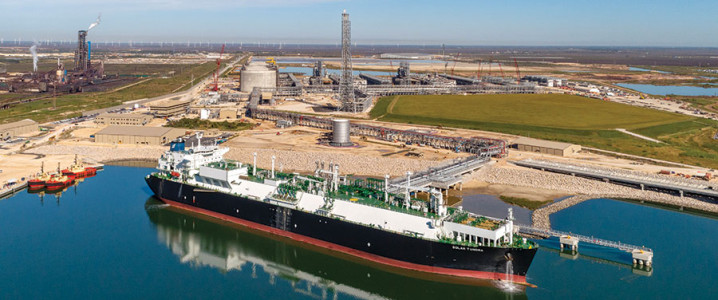
Cheniere Energy (NYSE: LNG) has a direct commercial opportunity from Qatar’s need to replace LNG production lost at Ras Laffan. QatarEnergy has moved beyond spot purchases and is now negotiating multi-year supply agreements with Cheniere, Venture Global and Woodside, potentially giving Cheniere a new source of contracted demand extending through 2031.
The timing is great for Cheniere. The company completed Corpus Christi Stage 3 on August 28, increasing LNG production capacity across Corpus Christi and Sabine Pass by more than 20% to approximately 56 million tonnes per year. Cheniere is also constructing Midscale Trains 8 and 9 at Corpus Christi, which are expected to add approximately 5 million tonnes per year of production capacity. At Sabine Pass, Cheniere is advancing the first phase of another expansion with expected capacity of more than 6 million tonnes per year, although that project remains subject to final investment approval and regulatory approvals.
Cheniere was already raising its 2026 outlook before QatarEnergy began seeking longer term U.S. supply. The company increased full year adjusted EBITDA guidance in August to $7.9 billion to $8.4 billion from $7.25 billion to $7.75 billion and raised expected distributable cash flow to $5.3 billion to $5.8 billion. It also tightened its 2026 LNG production forecast to 53 million to 54 million tonnes. In Q2, Cheniere generated $5.73 billion in revenue, $1.8 billion in adjusted EBITDA and $1.17 billion in distributable cash flow.
For investors, the QatarEnergy negotiations add another potential buyer just as Cheniere has completed a major expansion of its operating capacity. There is no announced Cheniere contract yet, so the immediate investment case is the combination of higher existing capacity, additional projects under development and the possibility of new multi year demand from QatarEnergy.
#4 Shell
Shell (NYSE: SHEL) is making enough money from higher energy prices, refining and commodity trading to absorb a significant hit to its own Middle East operations. Adjusted earnings reached $9.8 billion in Q2, up from $4.3 billion a year earlier and the second highest quarterly profit in the company’s history. Cash flow from operations reached $21.4 billion.
That came with roughly 20% of Shell’s prewar oil and gas production exposed to the Middle East and about 10% linked to Qatar. Shell owns the 140,000 bpd Pearl gas-to-liquids facility in Qatar, where one of its two processing trains was damaged. The other train was not damaged but could only restart when security conditions and the ability to export products allowed. Shell also owns 30% of QatarEnergy LNG N(4), representing 2.4 million tonnes per year of equity LNG production. QatarEnergy shut production across its LNG facilities in March and declared force majeure.
Integrated Gas still earned $2.7 billion in Q2, 55% more than a year earlier, even as gas production fell 31% from Q1. Higher realized prices and stronger LNG trading helped Shell absorb the impact of lower Qatar volumes. Shell operates the world’s largest LNG trading business, giving it a major position in a market where Qatari supply has fallen and cargoes are being redirected between regions.
Refining produced an even larger earnings jump. Shell’s Chemicals and Products division earned $2.9 billion in the second quarter, up from just $118 million a year earlier. Its refineries ran at 102% of nameplate capacity as fuel margins surged, while jet fuel production increased by about 20% from a year earlier.
Still, Shell carries more direct Gulf risk than Chevron or ConocoPhillips. In addition to its existing Qatar operations, the company owns interests in Qatar’s North Field East and North Field South LNG expansions. QatarEnergy has warned that continued Hormuz disruption could delay parts of the North Field expansion program.
Morgan Stanley upgraded Shell from Equal Weight to Overweight on September 4 and raised its U.S. share price target to $101.30 from $81.60. JPMorgan maintained its positive rating on September 8, while Goldman Sachs reiterated its Buy rating on September 11.
#5 Marathon Petroleum
Marathon Petroleum (NYSE: MPC) is the refining play on a prolonged disruption. The company operates the largest refining system in the United States, with 13 refineries and approximately 3 million barrels per day of crude processing capacity. Attacks on refineries in the Middle East and Russia have tightened global fuel supplies while U.S. fuel exports have climbed to record levels.
Marathon’s Q2 refining and marketing margin more than doubled to $36.33 per barrel from $17.58 a year earlier. Adjusted EBITDA from the refining and marketing business jumped to $6.7 billion from $1.9 billion, while companywide net income rose to $5.1 billion from $1.2 billion. Marathon processed 2.9 million bpd during the quarter with its refineries running at 94% utilization.
Marathon’s Gulf Coast refineries ran at 100% utilization during the quarter, while the company estimated that planned and unplanned refinery outages worldwide had climbed above 9 million bpd, roughly 4 million bpd above historical levels. U.S. distillate exports reached record highs during the quarter and U.S. jet fuel demand hit a record in June.
The fuel market has tightened further since Marathon reported those results. U.S. distillate inventories fell again in the latest EIA data, dropping another 400,000 barrels in the week ending September 18 and leaving stocks 12% below the five-year average. Diesel prices have climbed above $6.50 per gallon, with lost Middle Eastern and Russian fuel supplies leaving the global refining system short of replacement barrels. The squeeze has become severe enough that Washington spent this week debating restrictions on U.S. diesel exports before the White House ruled out a flat export ban on Wednesday.
Marathon is turning those refining profits into cash for shareholders. The company returned $2.8 billion through share repurchases and dividends in the second quarter, compared with $1 billion a year earlier.
Wall Street has been raising its estimates as refining margins remain elevated. Goldman Sachs raised its Marathon target from $376 to $472 this month and maintained its Buy rating.
Marathon’s Q2 refining margin had already more than doubled before U.S. diesel refining margins reached their September record. Its Gulf Coast refineries were running at full capacity, U.S. fuel exports were at record levels and global refinery outages were running roughly 4 million bpd above historical levels.
This post appeared first on https://oilprice.com